
Most companies think they’re misfiring because of marketing. They’re not. They’re misaligned.
The dangerous part is they don’t feel it right away. Revenue might still come in. Campaigns might still perform. The dashboard might even look healthy. But underneath it, something is off. The experience doesn’t match the promise, and the customer feels it long before the company admits it.
I was sitting with a leadership team recently who kept coming back to the same phrase. “We’re customer-centric.” They believed it. You could hear it in how often they repeated it. But as we started walking through the actual customer journey, step by step, something else showed up. Small points of friction. Moments of hesitation. Places where the customer had to work harder than they should. And metrics that told a clean story on the surface but ignored what the customer was actually going through.
That’s the gap. That’s where trust starts to erode.

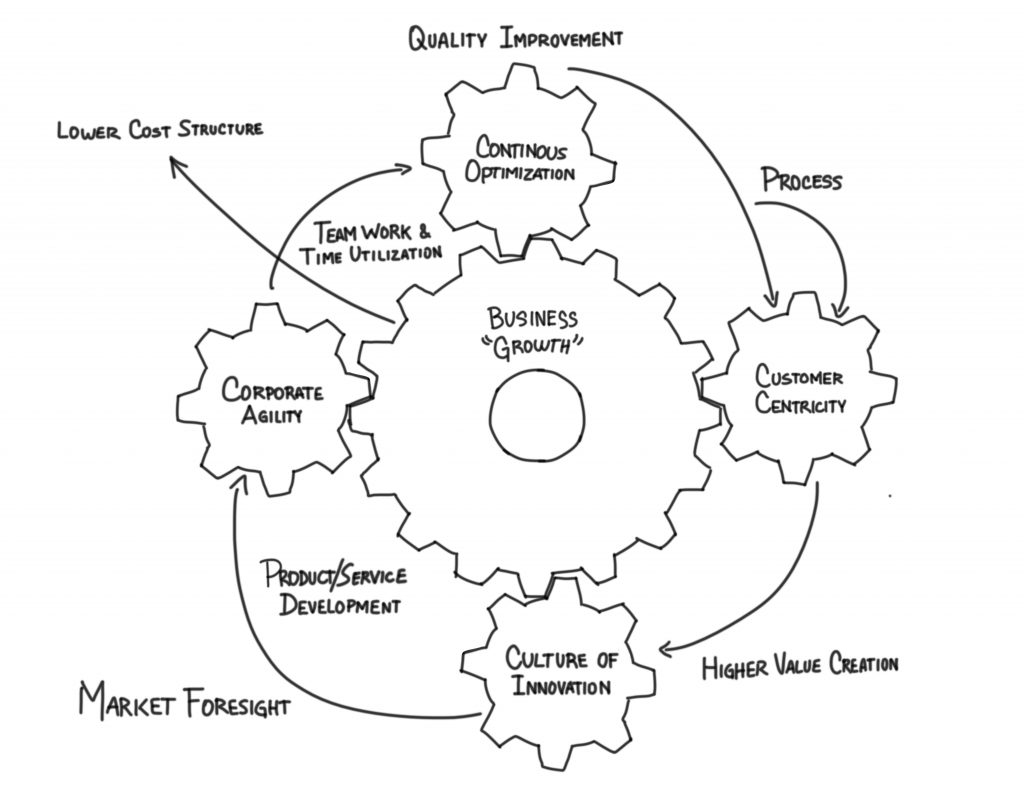
And this is exactly why the flywheel from Be Like Amazon matters more than most people realize. Not because it drives growth. That’s the part everyone talks about. Growth is the visible outcome, so it gets the attention.
Growth isn’t the point. Alignment is.
The flywheel works because it forces a company to operate from the outside in. It starts with the customer, not as a statement on a wall, but as a constraint that shapes every decision that follows. What does the customer expect right now? What are they trying to accomplish? What friction are they experiencing that you may not even see internally?
When you sit in that long enough, your thinking changes. You stop building based on assumptions and start responding to reality. Ideas become sharper. Priorities become clearer. You don’t need more brainstorming sessions. You need better inputs.
This is where it ties directly into I Think I Swallowed an Elephant.
We talk a lot about the stories we tell ourselves as organizations and the stories customers are actually living. When those two drift apart, performance suffers in ways that aren’t always obvious at first. Conversions dip. Engagement becomes inconsistent. Teams start pushing harder instead of stepping back to ask a more important question: are we even aligned with what the customer believes is happening?
The flywheel closes that gap.
It takes what could be abstract, like “customer-centricity,” and turns it into something operational. Something you can see. Something you can test. Something you can adjust.
Because once you move from understanding into execution, the truth shows up quickly.
Every touchpoint either reinforces your promise or contradicts it. There is no neutral. Customers don’t average their experiences. They remember the moments that felt easy and the moments that felt frustrating, and those moments shape what they believe about you going forward.
This is where most companies quietly fall out of alignment. Not because they don’t care, but because they don’t see it clearly.
They’re measuring activity instead of experience. They’re tracking outputs instead of outcomes. They can tell you how many people clicked, how many visited, how many converted, but they struggle to answer a simpler question. Did this actually make things better for the customer?
The flywheel forces that question into the center of the conversation.
Because when you start measuring what the customer feels, not just what they do, the picture changes. You see friction faster. You see opportunity faster. And most importantly, you can adjust before the gap gets too wide.
That’s where alignment becomes a living system instead of a one-time strategy.
Customer reality shapes action.
Action produces results.
Results reveal truth.
Truth drives adjustment.
And then it repeats.
Over and over again.
What makes this hard is not the model itself. The model is simple. What makes it hard is the honesty it requires.
Because alignment will always expose the distance between what you believe you’re delivering and what the customer is actually experiencing. And most organizations are far more comfortable protecting their internal story than they are confronting that gap.
But the companies that lean into it, the ones that let the customer redefine their assumptions, are the ones that build something much harder to replicate.
Consistency.
Clarity.
Trust.
Not because they said the right things, but because they aligned what they said with what they did.
So when you think about the flywheel, don’t think about speed. Think about alignment. Because when alignment is real, momentum takes care of itself. And when it’s not, no amount of effort will fix what the customer already feels.